


The best business for you might be in an industry you don’t know
People exploring Entrepreneurship through Acquisition (EtA) often ask me whether they should limit their search to industries they already understand.
There’s an obvious logic to doing that. If you’re going to put your capital, career and reputation behind an acquisition, familiarity is reassuring. You understand the language, know how the customers think and can probably recognise many of the problems before they appear.
But I think there’s a risk in making your known industry experience the starting point for an EtA search, because the better question may be less about what you already know and more about what you’re particularly good at.
When I left corporate banking in 2012, I wasn’t looking to launch a start-up or invent something new. I wanted direct accountability, greater autonomy, and the opportunity to build something where I could see the impact of the decisions I was making.
That eventually took me to SRO Technology, where I found myself sitting at a second-hand IKEA desk in the corner of a warehouse surrounded by people who knew considerably more about industrial engineering than I did.
I couldn’t operate the machinery and I certainly wasn’t going to become the technical expert in the room.
But what I could do was bring a different set of skills to the business and, over time, work out where those skills were useful.
That distinction has shaped how I think about business acquisition fit ever since.
‘Industry’ fit versus a ‘problem’ fit
There’s a fairly obvious version of business acquisition fit. An electrician buys an electrical services company, someone from logistics buys a transport business, or an executive from a particular sector acquires an SME somewhere in the same value chain.
Let’s call that first-order fit. Your experience maps directly to the industry you’re buying into, and there can be considerable value in that.
But there’s also what I think of as second-order fit, where your experience maps to the problems inside the business rather than the industry itself.
Take someone with a strong finance, analytics, or operations background looking at a field services business with 15 crews moving around Sydney.
They might know very little about performing the underlying trade, but if scheduling is poor, utilisation is inconsistent, and the business lacks good information about where its resources are going, they may be very well equipped to improve it.
The question then isn’t whether you could do the work yourself. It’s whether the business has problems that play to your strengths as an owner.
That opens up a much broader search universe.
Fresh eyes are useful. Humility is essential.
There is a genuine advantage in arriving without 20 years of industry conditioning. You’ll probably ask some fairly basic - and curious - questions, and often those questions uncover assumptions that haven’t been challenged for a long time.
The danger is assuming that because something looks strange to you, it must be wrong.
I learnt that fairly quickly at SRO. Coming from corporate banking, I brought some of the habits of that environment with me, including workshops, structured exercises and approaches that had seemed completely normal in a large organisation.
During one workshop, the former owner got up, walked out the door and downstairs and started building something in the workshop.
It was a reasonably clear piece of feedback!
I was never going to out-engineer the engineers, and pretending otherwise would have been ridiculous. What I needed to do was listen to the people who understood the machinery, customers and processes, then work out where my own experience could make the business better.
That’s an important discipline for any acquisition entrepreneur coming from outside an industry.
Being an outsider gives you permission to ask different questions, but it doesn’t give you permission to assume you already know the answers.
What trust actually looks like in an SME
That early period at SRO also changed the way I think about culture.
We sometimes make trust and psychological safety sound more complicated than they need to be. In a small business, they become very tangible.
If a machine doesn’t sound right, will someone tell you before it becomes an expensive problem? If a customer delivery is going to be late, do you hear about it early enough to do something? If you’re making a poor decision, is someone prepared to tell you?
The more important question is probably what happens after they do.
Trust at SRO wasn’t created through a workshop or a values statement. It was built through lots of relatively ordinary interactions:
- Listening when people raise problems.
- Removing things that made their jobs unnecessarily difficult.
- Following through on commitments and trying not to shoot the messenger when someone delivered news I didn’t particularly want to hear.
If you’re coming into an industry without decades of technical experience, you need those relationships because you simply can’t know everything yourself.
The owner’s job is different
One of the misconceptions I see among prospective business acquisition entrepreneurs is that they need to become an expert in everything the business does.
I don’t think they do.
If you acquire a company that has accumulated decades of technical knowledge, trying to replicate that knowledge yourself is probably a poor use of your time.
Your responsibility is to understand enough to recognise risk, ask useful questions and make good decisions, while creating the conditions for the experts already in the business to perform well.
You also need to understand where the business is vulnerable.
Is critical knowledge sitting with one person? What happens if they leave?
Which processes aren’t documented? Where are good people holding together bad systems through experience and goodwill? And where could better systems support those people rather than getting in their way?
Those questions have very little to do with being the best technician in the room.
They have a lot to do with being a good SME business owner.
The same principle applies in the boardroom
As the EtA market grows across Australia and New Zealand, I think this idea becomes important beyond the entrepreneur themselves.
We’re going to have more first-time CEOs taking responsibility for established SMEs, often coming from larger organisations or different industries.
They’ll need good people around them, but they don’t need boards that try to run the business on their behalf.
They need directors who understand when to challenge, when to provide some structure, when their own experience is useful, and when they should give the operator room to work through the problem.
It's also why communities like EtA Central are important, connecting people across the EtA ecosystem to share experiences, build relationships and learn from those who have navigated similar challenges.
I sometimes describe the distinction as being a carpenter versus being a gardener.
There are moments when a director needs to be a carpenter because something is broken, a structure is missing or a problem needs a direct intervention.
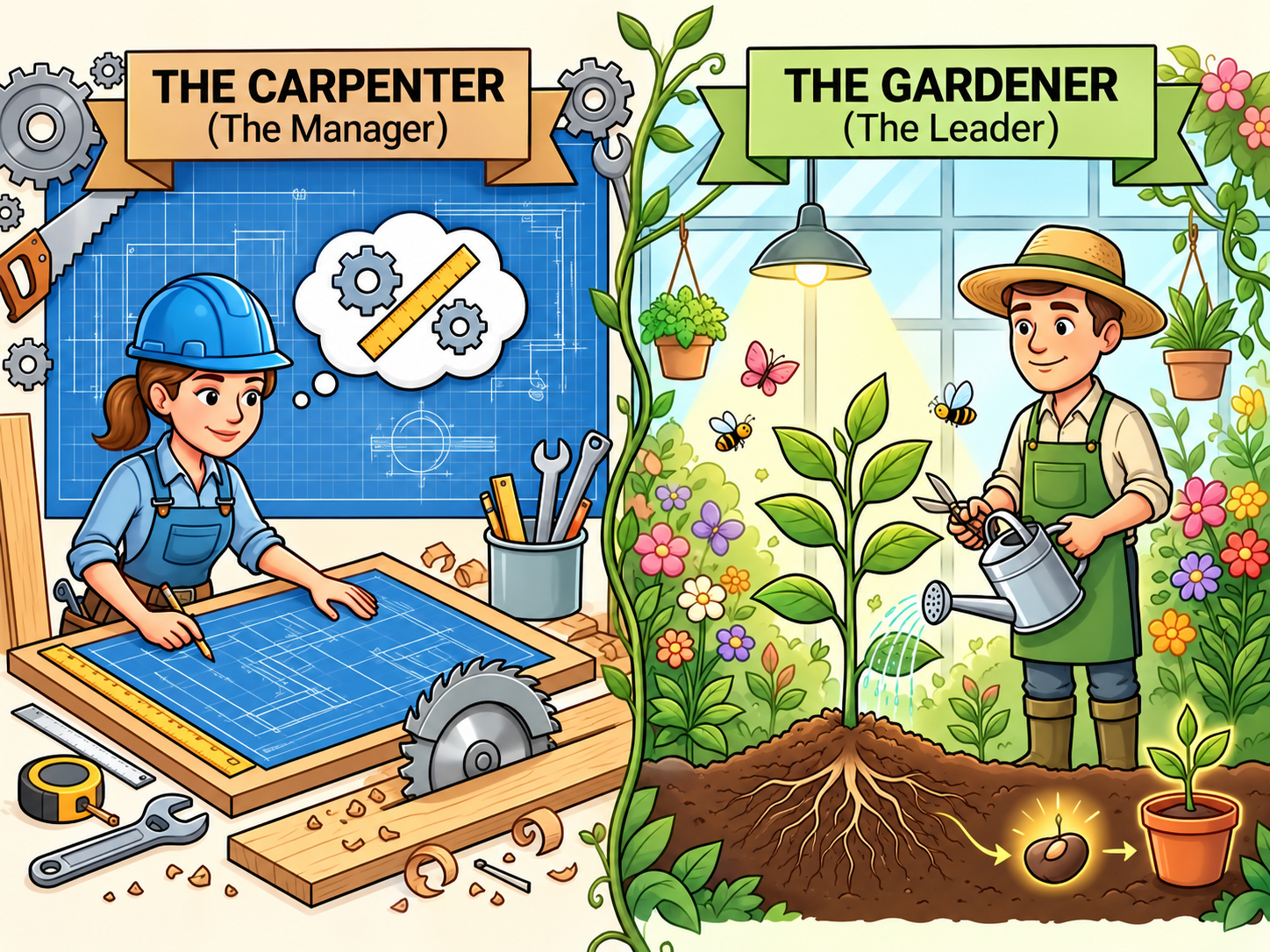
But much of good governance is closer to gardening.
You create the right conditions, provide perspective, remove obstacles where you can, and give the person running the business enough room to develop.
We’re going to need more people who can do that as the EtA ecosystem grows. They won’t necessarily be career directors.
Some of the most valuable people will be experienced operators and business leaders who understand what it feels like to carry responsibility for an SME and have enough judgement not to confuse advising an operator with becoming one again.
Look for the problems you are equipped to solve
None of this means industry experience is irrelevant. In some businesses, qualifications, specialist expertise or deep sector knowledge are fundamental, and no amount of general management experience can replace them.
But I wouldn’t automatically draw a circle around the industries on your CV and assume your move to business acquisition needs to sit inside it.
My own journey has moved from operating SRO, to supporting other acquisition entrepreneurs, and increasingly into governance.
The common thread hasn’t been knowing everything about every business. It has been about understanding where I can contribute, recognising where someone else knows far more than I do, and trying to exercise enough judgement to tell the difference.
For someone beginning an EtA search, I’d therefore spend less time asking "Which industries am I qualified to buy into?" and a little more time asking "What problems am I particularly well equipped to solve?"
The answer may take you outside the industries you know. That isn’t necessarily a weakness.
It might just be where your advantage is.
Let’s talk about your next step
Exploring business ownership through acquisition? Pete helps aspiring owners find, acquire and grow established businesses. Reach out to discuss EtA, Search Funds or an EtA consultation.
Get in touch with PetePete Seligman · EtA Investor · LinkedIn